Containers
uniTerm has a built-in container management interface supporting Kubernetes cluster management and the Docker / Podman / nerdctl / WSLC container runtimes. Manage cluster resources and container images on the local machine or on remote hosts over SSH.
Kubernetes
Connection Parameters
| Parameter | Description |
|---|---|
| Source | Local file (specify a kubeconfig path, with a file picker button) or Kubeconfig text (collapsed by default; click "Show Config" to expand and paste the content, with "Import from file" available) |
| Context | Select a context from the kubeconfig; click "Reload" to refresh the list |
| Namespace | The default namespace to view; check "All namespaces" to browse the whole cluster |
| Skip TLS verification | Skip API Server certificate validation (insecure, for self-signed test environments only) |
| SSH Tunnel | Optional. Access an internal cluster API through an SSH jump host |
After filling in the fields, click "Test Connection" to verify the kubeconfig and network reachability.
Resource Browsing
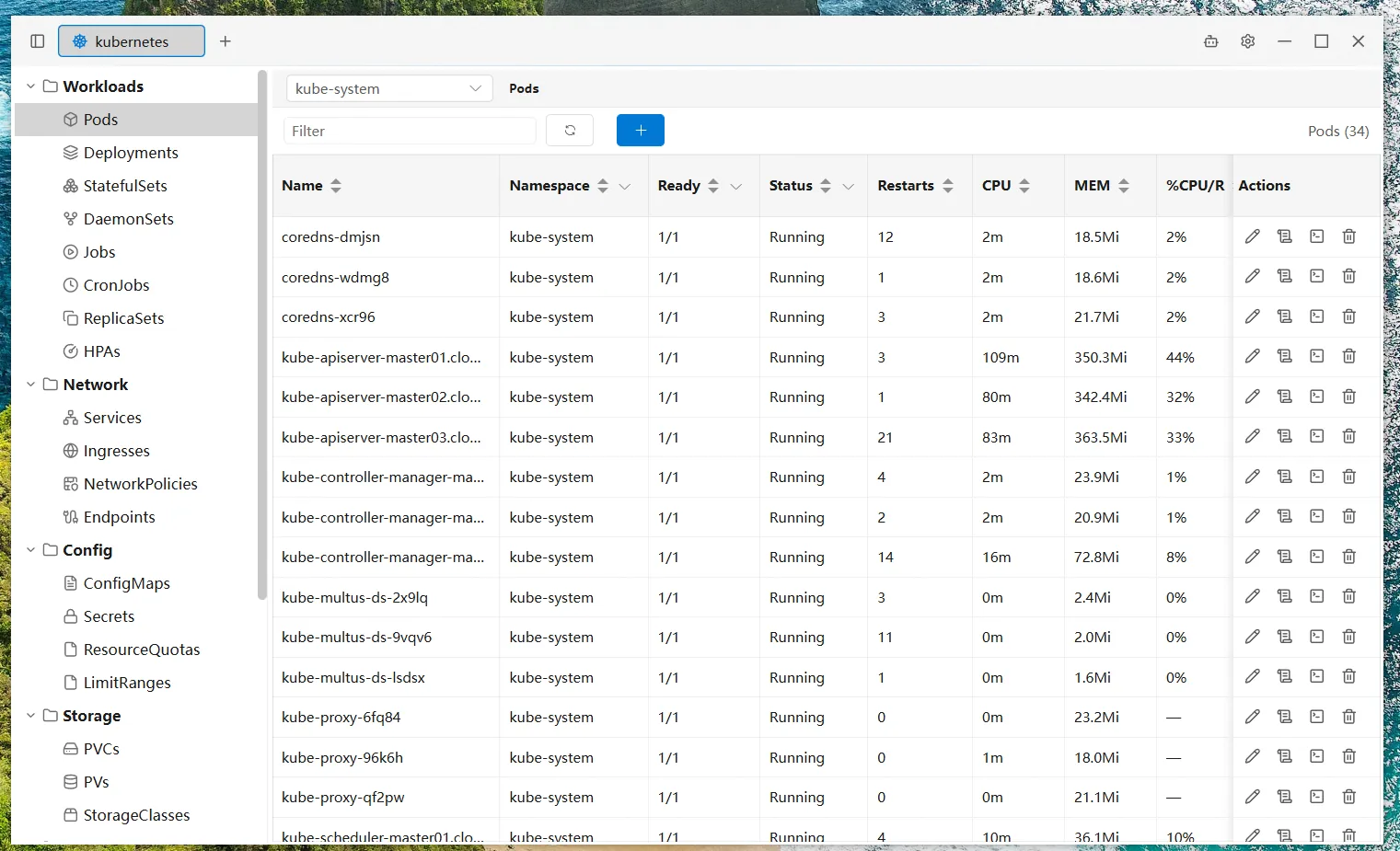
The left tree panel groups cluster resources by category, watches for changes, and refreshes automatically:
| Group | Resources |
|---|---|
| Workloads | Pods, Deployments, StatefulSets, DaemonSets, ReplicaSets, Jobs, CronJobs, HPAs |
| Network | Services, Ingresses, Endpoints, NetworkPolicies |
| Config | ConfigMaps, Secrets, ResourceQuotas, LimitRanges |
| Storage | PVCs, PVs, StorageClasses |
| RBAC | ServiceAccounts, Roles, RoleBindings, ClusterRoles, ClusterRoleBindings |
| Cluster | Nodes, Namespaces, Events, CRDs |
- Top filter — Filter in real time by name, status, namespace, and other columns
- Health highlighting — Not-ready Pods, under-replicated workloads, and NotReady nodes are highlighted row-wide
- Live metrics — Pod and Node lists show CPU / memory usage and its percentage of requests/limits (requires metrics-server installed in the cluster)
Resource Actions
After selecting a resource, the right-click menu or inline action buttons provide the following (varies by resource type):
- Detail — A side drawer shows the full metadata, Spec, Status, and other fields
- Edit — Edit the resource YAML directly and apply
- Create — Create resources from a built-in YAML template
- Scale — Change the replica count of a Deployment / StatefulSet / ReplicaSet
- Restart — Rolling-restart a workload
- View Pods — Jump to the Pod list associated with the workload/node
- Cordon / Drain — Mark a node unschedulable or evict its Pods
- Delete — Delete after confirmation, with optional force delete (skip graceful termination)
Pod Logs and Terminal
- Logs — Follow Pod logs in real time, with pause/resume, timestamps, previous container, auto-scroll, wrap, and clear
- Terminal — Exec directly into a Pod container for an interactive shell
Container Engines
Four runtimes are supported: Docker, Podman, nerdctl (containerd), and WSLC (Windows WSL2 Container, Windows only). Choose the subtype when creating a new connection.
Connection Parameters
| Parameter | Description |
|---|---|
| Transport | Remote host (SSH) (default) reuses an existing SSH connection — inheriting its credentials and jump host configuration — to manage containers on a remote host; Local machine uses the container runtime installed on this machine |
| SSH Connection | When the transport is remote host, select a saved SSH connection as the channel |
nerdctl supports switching the containerd namespace from the top bar. The WSLC runtime does not offer the "Restart" or "Rename" actions.
Container Management
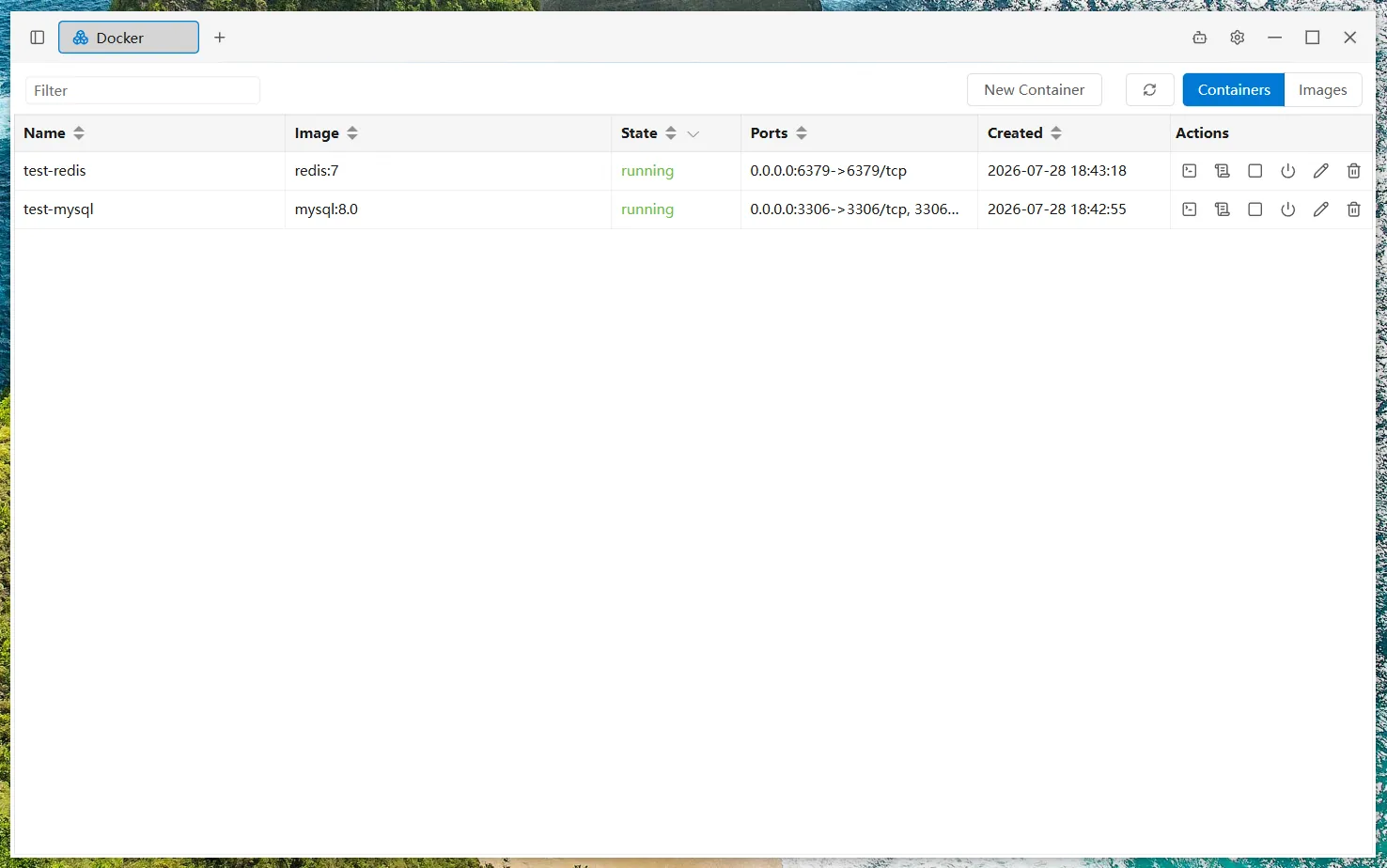
The top tabs switch between the "Containers" and "Images" views.
The container list shows name, image, state, port mappings, and creation time, with the following actions:
- Lifecycle — Start, stop, restart, pause, unpause
- Exec — Enter an interactive terminal in the container
- Logs — View container log output
- Rename — Change the container name
- Remove — Remove the container after confirmation
- Detail — View overview, command, network, mounts, environment, and state
- New Container — Create a container by specifying image, name, port mappings, volumes, environment variables, restart policy, and command
Image Management
The image list shows repository, tag, ID, and size, and supports:
- Pull — Pull an image from a registry by name (e.g.
nginx:latest) - Remove — Remove the image after confirmation
Related
- Remote Terminal — SSH connection and jump host configuration
- Supported Protocols — Full protocol and port list